

Travel Requirements &
Health Information
Everything You Need to Know Before Traveling to Tanzania
Prepare for a smooth journey with essential information on visas, passport requirements, vaccinations, health advice, currency, packing tips, and travel safety.
Preparing for Your Tanzania Adventure
Planning ahead will help ensure a smooth and enjoyable journey to Tanzania. Before departure, make sure you understand the country’s visa requirements, passport validity rules, health recommendations, currency guidelines, and luggage regulations.
Whether you’re arriving at Kilimanjaro International Airport (JRO), Julius Nyerere International Airport (DAR), or Abeid Amani Karume International Airport (ZNZ), having the correct travel documents will make your arrival quick and hassle-free.
Important: Entry requirements and health regulations may change. Always confirm the latest information with the Tanzanian Immigration Department and your local travel health authority before traveling.
Entry Requirements
Passport
All visitors must have:
- A passport valid for at least 6 months from the date of arrival.
- At least two blank pages for entry and exit stamps.
- A return or onward travel ticket.
- Proof of accommodation or sufficient funds if requested by immigration authorities.
Tourist Visa
Most international visitors require a tourist visa to enter Tanzania.
Standard Tourist Visa
- Available as an eVisa before travel or Visa on Arrival for many nationalities.
- Standard fee is generally USD 50 for many eligible nationalities.
- U.S. passport holders are generally required to obtain a USD 100 Multiple Entry Visa, even for short leisure visits.
- eVisa processing typically takes several business days, while Visa on Arrival processing depends on airport procedures.
Always check the official Tanzania Immigration website to confirm your eligibility and the latest visa requirements.
Health & Vaccination Information
Yellow Fever
A Yellow Fever vaccination certificate (Yellow Card) is required only if you are arriving from, or have transited for more than 12 hours through, a country where Yellow Fever is a transmission risk.
Travelers arriving directly from countries without Yellow Fever risk generally do not need to present a certificate.
If required, the vaccination must be administered at least 10 days before arrival.
Malaria Prevention
Malaria is present throughout much of Tanzania, including many safari destinations and coastal regions.
Before traveling, consult your healthcare provider about suitable antimalarial medication.
Additional protection includes:
- Using insect repellent containing DEET or picaridin.
- Wearing long sleeves and trousers during evenings.
- Sleeping under mosquito nets where provided.
- Choosing accommodation with screened rooms whenever possible.
Money & Currency
The local currency is the Tanzanian Shilling (TZS), although U.S. Dollars are widely accepted at many hotels, safari lodges, and tourism businesses.
Important Currency Rules
- U.S. Dollar notes should be clean and undamaged.
- Many banks, exchange bureaus, and tourism businesses accept only U.S. Dollar notes printed in 2013 or later.
- Carry small denominations for tipping and incidental expenses.
- Credit cards are accepted in many hotels and lodges, though a surcharge may apply.
ATMs are available in major cities but are uncommon inside national parks.
Safari Packing Checklist
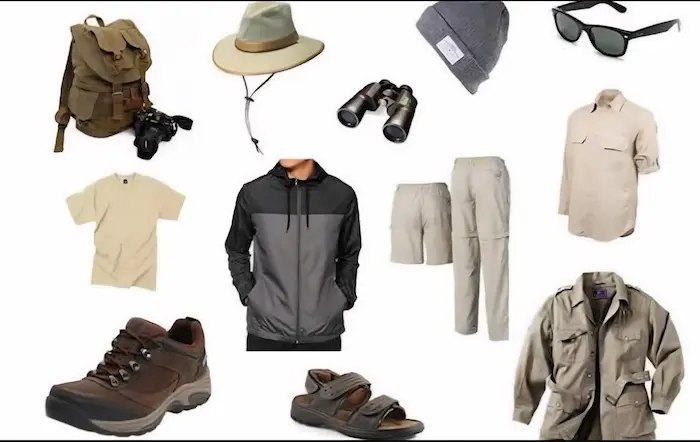
Clothing
- Lightweight neutral-coloured clothing (khaki, olive, beige)
- Long trousers for evenings
- Lightweight long-sleeved shirts
- Warm fleece or jacket for early morning game drives
- Comfortable walking shoes
- Wide-brim sun hat
- Swimwear for beach destinations
- Light rain jacket during the Green Season
Essential Equipment
- Binoculars (8×42 or 10×42 recommended)
- Camera with zoom lens
- Extra batteries and memory cards
- Universal travel adapter (Type G – UK standard)
- Portable power bank
- Waterproof dry bag
- Sunglasses
- Reusable water bottle
Health Essentials
- Prescription medications
- Antimalarial medication
- Insect repellent
- SPF 50+ sunscreen
- Lip balm
- Personal first-aid kit
- Hand sanitizer
Carry medications in their original packaging together with any required prescriptions.
Frequently Asked Questions
Yes. Tanzania is widely regarded as one of Africa’s most welcoming and stable travel destinations. National parks and safari areas are very safe, while normal precautions should be taken in busy towns and cities.
No. Visitors should drink bottled or properly purified water throughout their trip.
Drone use is strictly regulated in Tanzania and generally requires prior government approval. Drones are prohibited in many national parks and protected areas without official authorization.
Yes, many hotels, lodges, and restaurants accept major credit cards, although cash is recommended for tips, local markets, and smaller businesses.
Comprehensive travel insurance that includes emergency medical treatment, evacuation, trip cancellation, and baggage cover is strongly recommended for all travelers.
Start Planning Your Tanzania Adventure
Whether you dream of witnessing the Great Migration, climbing Mount Kilimanjaro, exploring the Ngorongoro Crater, relaxing on Zanzibar’s beaches, or discovering Tanzania’s remarkable cultures, every journey is tailored to create lifelong memories. Our travel specialists are ready to help you design a personalized Tanzania itinerary that matches your interests, travel style, and budget.
Begin your unforgettable journey through Tanzania today.